10 Signs of Dementia You Should Never Ignore

What you’re noticing is not just a formatting problem, but a deeper structural issue in how information is delivered. Many modern articles follow a “content feed” model, where the main goal is to keep attention rather than provide detailed, accurate explanations. This approach often includes unrelated promoted content, which disrupts focus and shifts the reader from understanding to quick consumption.

Because of this structure, even correct information can feel incomplete. Readers are encouraged to scan rather than fully process what they are reading. This is especially problematic with complex topics like dementia, where nuance and context are essential for proper understanding.

Dementia itself is often oversimplified in such articles. While it is correctly described as a general term for cognitive decline, it actually includes multiple conditions, such as Alzheimer’s disease, vascular dementia, and others. Each type has different causes and symptoms, which are rarely explained in depth.

Similarly, lists of early warning signs lack important context. Occasional forgetfulness is normal, but dementia involves consistent, progressive issues that interfere with daily life. Without explaining these differences, articles can either cause unnecessary fear or lead people to overlook serious symptoms.

The same pattern appears in advice about early detection and lifestyle. While awareness is important, proper diagnosis requires professional evaluation, not self-assessment. Guidance from organizations like the Alzheimer’s Association emphasizes this distinction, yet simplified articles often reduce it to brief mentions.

In the end, the problem is not outright misinformation, but lack of depth. These articles mix valid points with oversimplification and distraction. Treating them as a starting point rather than a final source, and seeking more reliable information, allows for a clearer and more accurate understanding of complex health topics.


Related Posts

Singing Just for You Today”: Sweet Moment Leaves Viewers Smiling ❤️🎤

Singing Just for You Today”: Sweet Moment Leaves Viewers Smiling ❤️🎤

A short, heartwarming clip is bringing smiles across social media as a young voice shares a simple but uplifting message: singing “just for you today.” In the…

My Husband Told Me “If You Want to Eat, Pay for Your Own Food” — So I Turned Off the Stove on His Birthday

My Husband Told Me “If You Want to Eat, Pay for Your Own Food” — So I Turned Off the Stove on His Birthday

Richard’s birthday was supposed to be a celebration, but it quickly became a turning point in our relationship. His entire family arrived expecting a homemade feast, yet the kitchen was… CONTINUE READING

The Stranger at My Table: The Secret My Mother Kept for 20 Years Will Leave You Speechless

The Stranger at My Table: The Secret My Mother Kept for 20 Years Will Leave You Speechless

I stood there trembling, holding flowers, as a family friend finally revealed a truth that shattered everything I believed about my childhood. For twenty years, I had carried the pain… CONTINUE READING

After I Lost My Job, My Husband Demanded We Split Everything 50/50—Then I Discovered Secrets

After I Lost My Job, My Husband Demanded We Split Everything 50/50—Then I Discovered Secrets

Elena never expected losing her job to change her marriage. After being laid off, she returned home hoping for support from her husband, Thomas, after eight years together. Instead, she… CONTINUE READING

Why More Drivers Are Displaying Upside-Down State Flags—and What It Means

Why More Drivers Are Displaying Upside-Down State Flags—and What It Means

If you’ve driven through the Pacific Northwest, you may have noticed an upside-down outline of Washington State on some vehicles. It often looks like a mistake at first, but it’s… CONTINUE READING

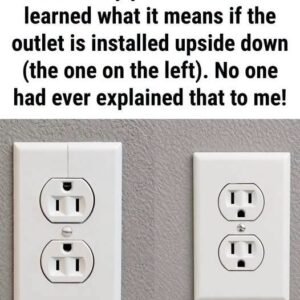
Why Some Wall Outlets Are Installed Upside Down: The Practical Reason Behind It

Why Some Wall Outlets Are Installed Upside Down: The Practical Reason Behind It

If you’ve ever seen a wall outlet with the ground hole facing upward, it might look like a mistake—but it often isn’t. In many cases, the orientation is intentional and… CONTINUE READING