Why Women’s Shirts Button on the Left and Men’s on the Right: A Historical Fashion Tradition Rooted in European Class Structure, Servant-Assisted Dressing, and Practical Needs of Men Carrying Weapons, Showing How Centuries-Old Social Customs Became Standardized Into Modern Clothing Design and Still Persist Today as a Subtle Remnant of Historical Gender Roles

The difference in button placement between men’s and women’s shirts is a small detail that actually reflects a long history of social structure and clothing design. While modern clothing is mass-produced for convenience and style, many of its features come from older traditions that once had practical meaning. Clothing has always reflected how societies were organized, and even minor design choices can carry historical traces.

The most common explanation for women’s buttons being on the left side comes from upper-class Europe in the 18th and 19th centuries. Wealthy women often wore complex layered outfits and rarely dressed themselves. Since maids—usually right-handed—helped them dress, placing buttons on the left made fastening easier from an assistant’s perspective.

As fashion spread beyond aristocratic elites, these design choices were widely copied. Clothing was a symbol of status, so lower classes imitated upper-class styles. Later, industrial garment production standardized these patterns, preserving button placement conventions even after assisted dressing became uncommon.

Men’s clothing developed differently because men generally dressed themselves. Garments were designed for practicality and ease of movement. Some historians also note that men often carried weapons on the left side, so right-side buttoning supported accessibility and self-dressing efficiency.

Over time, the original reasons for these differences faded as societies changed. Servant-assisted dressing became rare, and weapons were no longer part of daily civilian life. However, the established clothing templates remained in place due to manufacturing habits and consumer expectations.

Once factories began mass-producing clothing, consistency mattered more than redesigning small details. Because people were already used to the distinction, manufacturers continued using the same button orientations, reinforcing them as “normal” rather than functional.

Today, the difference has little practical purpose. Most people dress independently, and clothing design focuses on comfort and style. Still, the convention persists as a quiet reminder of how historical practices can survive through repetition long after their original context disappears.

In this way, something as simple as shirt buttons becomes a subtle link to the past, showing how everyday objects can preserve traces of social history even when their original meaning is largely forgotten.


Related Posts

Singing Just for You Today”: Sweet Moment Leaves Viewers Smiling ❤️🎤

Singing Just for You Today”: Sweet Moment Leaves Viewers Smiling ❤️🎤

A short, heartwarming clip is bringing smiles across social media as a young voice shares a simple but uplifting message: singing “just for you today.” In the…

My Husband Told Me “If You Want to Eat, Pay for Your Own Food” — So I Turned Off the Stove on His Birthday

My Husband Told Me “If You Want to Eat, Pay for Your Own Food” — So I Turned Off the Stove on His Birthday

Richard’s birthday was supposed to be a celebration, but it quickly became a turning point in our relationship. His entire family arrived expecting a homemade feast, yet the kitchen was… CONTINUE READING

The Stranger at My Table: The Secret My Mother Kept for 20 Years Will Leave You Speechless

The Stranger at My Table: The Secret My Mother Kept for 20 Years Will Leave You Speechless

I stood there trembling, holding flowers, as a family friend finally revealed a truth that shattered everything I believed about my childhood. For twenty years, I had carried the pain… CONTINUE READING

After I Lost My Job, My Husband Demanded We Split Everything 50/50—Then I Discovered Secrets

After I Lost My Job, My Husband Demanded We Split Everything 50/50—Then I Discovered Secrets

Elena never expected losing her job to change her marriage. After being laid off, she returned home hoping for support from her husband, Thomas, after eight years together. Instead, she… CONTINUE READING

Why More Drivers Are Displaying Upside-Down State Flags—and What It Means

Why More Drivers Are Displaying Upside-Down State Flags—and What It Means

If you’ve driven through the Pacific Northwest, you may have noticed an upside-down outline of Washington State on some vehicles. It often looks like a mistake at first, but it’s… CONTINUE READING

Why Some Wall Outlets Are Installed Upside Down: The Practical Reason Behind It

Why Some Wall Outlets Are Installed Upside Down: The Practical Reason Behind It

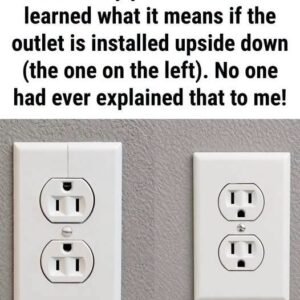
If you’ve ever seen a wall outlet with the ground hole facing upward, it might look like a mistake—but it often isn’t. In many cases, the orientation is intentional and… CONTINUE READING