THE BILLIONAIRE WIFE SLAPPED THE MAID FOR THROWING AWAY THE BABY’S MILK… THEN SHE WATCHED THE SECURITY VIDEO
–>
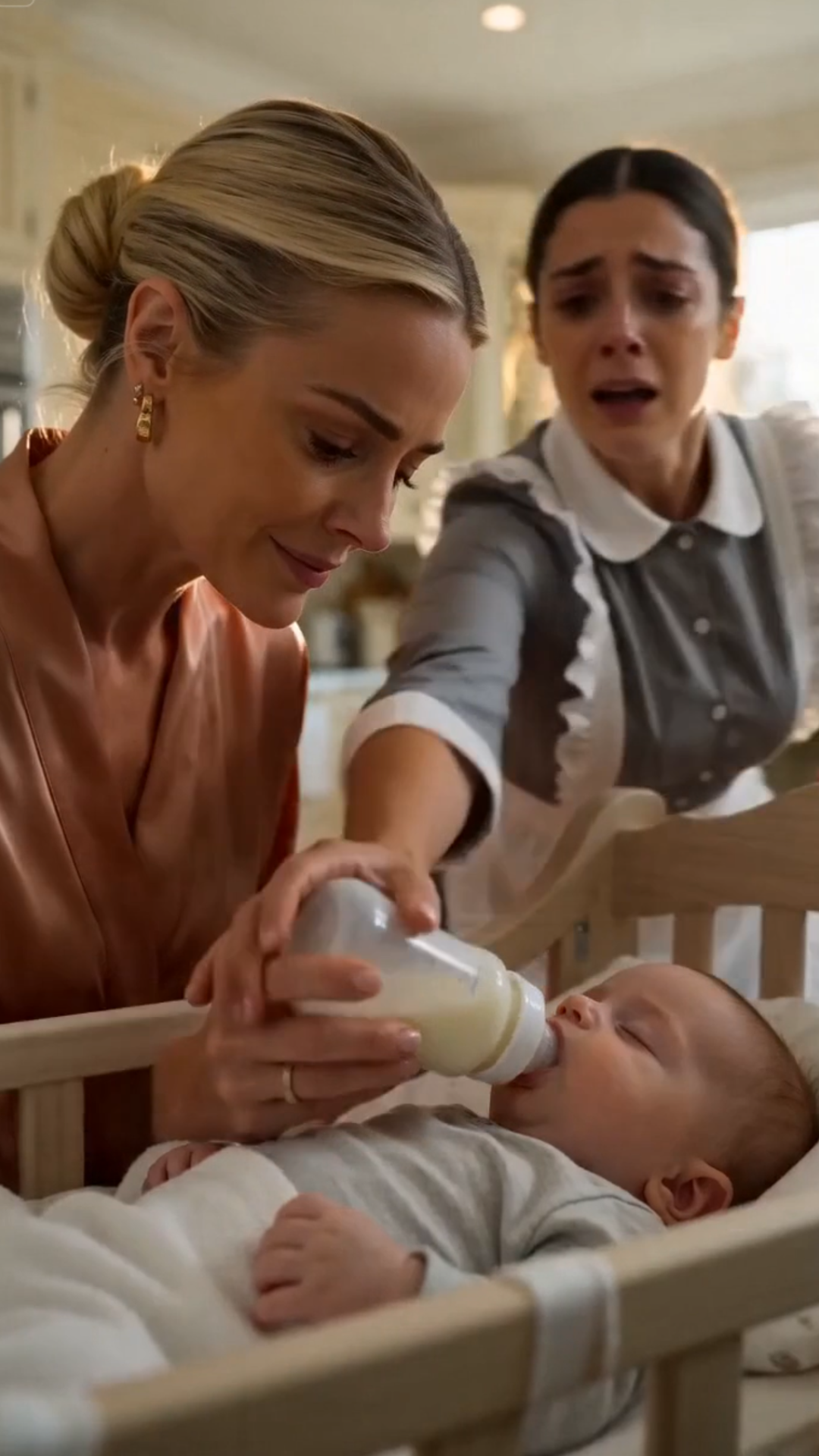
The sun broke beautifully through the floor-to-ceiling windows of the wealthy penthouse, washing over a clean, minimalist nursery. In the center of the room sat a modern white crib where an innocent, newborn baby lay sleeping soundly.
Victoria, dressed in a luxurious blush-pink silk robe, smiled down at her child. Her life was perfect, or so she thought. She reached for a freshly prepared baby bottle resting on the counter, ready to feed her infant.
Suddenly, a blur of motion disrupted the peaceful room.
Maria, the young live-in maid, scrambled past Victoria. Her face was twisted into a mask of pure terror. Before Victoria could react, Maria snatched the baby bottle directly out of her hands, spun around, and sprinted toward the kitchen island.
Faucets roared.
With trembling hands, Maria turned the bottle upside down, dumping the white milk directly into the sink, watching it swirl helplessly down the drain.
Act II: The Strike of Ignorance
“What are you doing?!” Victoria screamed, her voice piercing the quiet house.
Infuriated by what she saw as a direct act of insubordination and disrespect, Victoria lunged forward. With a sharp, resounding CLAP, her palm struck Maria hard across the face.
Maria stumbled backward, crashing onto the kitchen floor. She clutched her bruised cheek, her eyes wide and flowing with hot tears.
“That’s my baby’s milk!” Victoria barked, pointing an angry, manicured finger at the empty bottle. “Have you lost your mind?!”
“I was protecting your child!” Maria wept from the floor, her voice cracking under the weight of the physical and emotional assault.
“Stay away from my baby!” Victoria yelled, her breathing heavy, completely blind to anything but her own anger.
Act III: The Screen of Truth
From the cold floor, Maria didn’t look back with hatred. Instead, her shaking hand reached into her apron pocket and pulled out her smartphone. She tapped the screen and held it up toward Victoria.
“Look,” Maria whispered, her voice trembling.
Victoria frowned, her eyes drifting downward to the bright screen. The video began to play. It was a secret recording from a hidden angle in the kitchen. On the screen, a man—Victoria’s own husband—was standing over the counter. He held a large jar filled with a mysterious, fine white powder. With a cold, calculated look on his face, he poured spoonful after spoonful of the toxic substance directly into the baby’s formula.
Victoria’s eyes widened into dinner plates. The breath completely left her lungs. Her face drained of all color, her jaw dropping in absolute, paralyzed horror. The man she trusted, the father of her child, was systematically poisoning their newborn for an inheritance.
She looked down at Maria, who was still kneeling on the floor, holding her slapped face.
“I lost your trust to save your child,” Maria sobbed softly against the marble tiles.
The silence in the penthouse became deafening. Victoria stood frozen between the crib of her living baby and the sink full of poisoned milk, fully aware that the person she had just brutally struck was the only reason her child was still breathing.
googletag.cmd.push(function() { googletag.display(‘div-gpt-ad-1762435026570-0’); });
–>
THE NANNY SAID THE TODDLER FELL BY ACCIDENT… UNTIL HIS MOTHER CHECKED THE TEDDY BEAR CAMERA
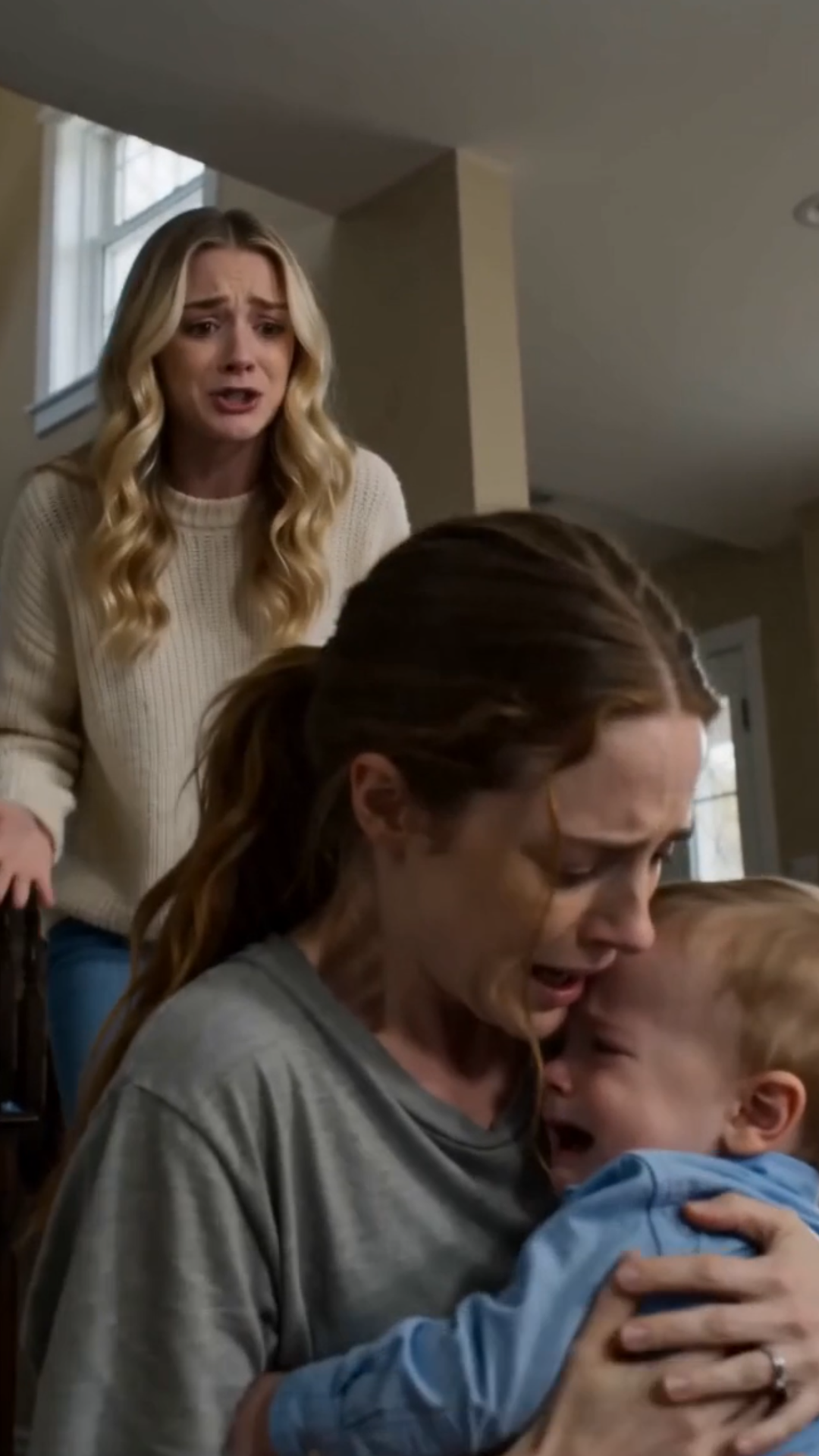
The sound of a toddler tumbling down carpeted stairs is distinct, a sickening succession of heavy, hollow thuds that imprints itself onto the back of your skull forever. It is a sound that nullifies the air in your lungs.
I was standing in the kitchen, the steam from a neglected pot of chamomile tea rising into my face, when that sound shattered the fragile, expensive silence of my suburban home. Then came the scream. Not the angry, demanding cry of a two-year-old who didn’t get his way, but the shrill, breathless shriek of pure, unadulterated terror.
I dropped the mug. It shattered against the white quartz countertop, splashing hot amber liquid across my bare feet, but I didn’t feel it. I was already sprinting toward the foyer, my heart hammering against my ribs like a trapped bird.
“Leo!” I gasped, the name catching in my throat.
At the bottom of the landing, splayed out on the hard oak flooring where the hallway runner ended, was my two-year-old son. His small body was twisted, his favorite stuffed rabbit pinned beneath his chest. Above him, clutching the wooden banister with knuckles white from strain, stood Clara.
Clara was our twenty-four-year-old babysitter, a girl with a face like a Renaissance painting and a resume that had made my husband, David, and me feel like we’d won the lottery. She had a degree in early childhood development from Penn State, glowing recommendations from three prominent families in the neighborhood, and a soft, rhythmic voice that could soothe Leo into sleep within minutes.
Right now, her soft voice was gone, replaced by a high-pitched, trembling panic. “Oh my god, Sarah! I’m so sorry! He just—he tripped. He was running for his rabbit and he slipped. It happened so fast. I tried to catch him, I swear I tried.”
I ignored her. I dropped to my knees, my hands shaking so violently I could barely lift my own child. “Leo, baby, look at Mommy. Look at Mommy.”
His face was bright red, tears tracking through the light dust from the stairs, and a dark, swelling bruise was already blooming across his left temple. He wasn’t crying anymore; he was hyperventilating, his tiny chest heaving as he stared past me. Not at me. Past me. Toward the top of the stairs.
“It’s okay, buddy, Mommy’s here,” I whispered, pulling his fragile weight against my chest. He was trembling so hard his teeth chattered.
“I only turned my back for a second to grab his juice box,” Clara stammered, coming down the stairs slowly, her hands raised as if to defend herself against an accusation I hadn’t even made yet. “He’s just so fast lately, Sarah. You know how he is. He’s in that phase where he thinks he’s invincible.”
I looked up at her. The afternoon sun was streaming through the heavy glass of the front door, catching the sharp angles of her cheekbones. She looked devastated. Her eyes were wide, welling with genuine tears, and her lower lip quivered. She looked exactly like a young woman who was terrified she had just let a tragedy happen on her watch.
But something in the back of my mind, a cold, primitive instinct that had nothing to do with logic, locked its jaws around my spine.
This was the second time in three weeks.
To everyone else in our pristine, gated community of Whispering Pines, Delaware, I was a woman who had it all. My husband, David, was a senior partner at a corporate law firm in Wilmington, a man whose ambition was matched only by his absolute devotion to providing for his family. We lived in a five-bedroom colonial with a manicured lawn, drove European SUVs, and hosted the annual neighborhood block party.
But if you scraped away the top layer of expensive paint, the house was built on a foundation of grief.
Four years before Leo was born, we had a daughter. Her name was Maya. She lived for exactly three days before a congenital heart defect claimed her in a sterile hospital room that smelled of rubbing alcohol and despair. David had handled the grief the only way he knew how: by burying himself in contracts, briefs, and eighty-hour workweeks. He built a wall of financial security so high that no tragedy could ever climb over it again.
I, on the other hand, had broken. I quit my job as a graphic designer, withdrew from my friends, and spent years navigating a gray, formless depression. When Leo was born, he wasn’t just a son; he was the oxygen that brought me back to life. Every breath he took was a miracle I felt personally responsible for maintaining.
“He needs to go to the ER, Sarah,” Clara said, her voice dropping into that professional, reassuring register that had comforted me so many times before. “Just to be safe. Head injuries can be tricky with toddlers.”
“Yes,” I breathed, my voice sounding hollow to my own ears. “The ER.”
As I carried Leo to the car, his small hands clutching the collar of my shirt with a desperate, white-knuckled grip, I passed the large, plush teddy bear sitting on the antique console table in the hallway.
It was a beautiful, vintage-style bear with soft brown fur and amber glass eyes. David’s mother had bought it for Leo’s birthday. It looked perfectly innocent, a charming piece of nursery decor that had spilled out into the main living space.
But it wasn’t just a toy. Inside the left eye of that teddy bear was a high-definition, motion-activated camera lens with a direct feed to an encrypted cloud server.
David didn’t know about it. Clara didn’t know about it.
I had ordered it online late one night a week ago, sitting in the dark while the rest of the house slept, driven by a dark, gnawing paranoia that I couldn’t explain to my husband without sounding like I was losing my mind again. The first time Leo fell, Clara said he had tripped over his own fire truck at the top of the stairs. He had ended up with a fractured collarbone. David had accepted it immediately—kids are clumsy, accidents happen, we have the best nanny money can buy.
But Leo had stopped talking to Clara. He had stopped looking her in the eye. And every time she walked into the room, he would find a way to crawl into my lap, hiding his face in the crook of my neck.
“Just an accident,” David had insisted that night, rubbing his temples. “Sarah, you’re projecting. You’re letting the trauma from Maya color everything. Clara is a professional. Her references are impeccable.”
Maybe he was right. Maybe I was crazy.
But as I buckled Leo into his car seat, my fingers fumbling with the heavy plastic buckles, I knew that the server had been recording for the last twelve hours. The truth, whatever it was, was sitting in a digital file on my phone.
The emergency room at Wilmington General was a sensory assault of fluorescent lights, crying children, and the low, rhythmic hum of medical equipment. It was a place I hated with every fiber of my being; it held too many echoes of Maya’s brief, agonizing life.
David met us there forty minutes after I called him. He arrived still wearing his tailored charcoal suit, his silk tie slightly loosened, his face a mask of controlled anxiety. He was forty-two, with silver threading through his dark hair and a permanent crease between his brows that had deeped over the last few years.
“Is he okay?” David asked, his voice low as he dropped into the plastic chair next to me in the examination room. He reached over, taking Leo’s small, uninjured hand. Leo was asleep, exhausted from the crying and the low-dose pain medication the triage nurse had given him.
“CT scan was clear,” I whispered, my voice cracked and dry. “No skull fracture. Just a severe concussion and soft tissue bruising. They want to keep him for observation for a few hours because of the previous injury.”
David let out a long, shuddering breath, his shoulders dropping two inches. “Thank God. Thank God.” He leaned back, rubbing his face with both hands. “How did it happen this time, Sarah? Did she say?”
“She said he was running for his rabbit. Tripped at the top landing.”
David sighed, a sound heavy with exhaustion. “We need to carpet those stairs entirely. Or put up a heavier gate. The pressure-mounted one clearly isn’t working if he can bypass it or if it was left open.”
“Clara said it was open,” I murmured, watching the slow rise and fall of my son’s chest. “She said she was fetching his juice.”
“It’s a terrible accident, Sarah, but it’s the second one,” David said, his legal mind automatically shifting into risk-mitigation mode. “We might have to consider finding someone else. Not because Clara is bad—she’s wonderful—but maybe she’s just not attentive enough for a kid as active as Leo is becoming.”
I looked at my husband. He was a good man. He loved our son with a fierce, quiet intensity, but his mind operated on logic, statistics, and probabilities. To him, an accident was just an unfortunate data point.
To me, it felt like a deliberate tear in the fabric of my reality.
“I’m going to the cafeteria to get us some coffee,” David said, standing up and smoothing his suit jacket. “Do you want anything to eat?”
“No. Just water.”
The moment the heavy wooden door clicked shut behind him, the room fell into a terrifyingly quiet stillness, broken only by the rhythmic electronic beep of the vitals monitor.
My phone felt heavy in my pocket. It felt hot, like a live coal pressing against my thigh.
I pulled it out. My hands were shaking so badly I almost dropped it onto the linoleum floor. I unlocked the screen, bypassed the notifications from my family and friends, and opened the proprietary app for the hidden nanny cam.
The interface was simple: a timeline of events marked by red vertical bars wherever the camera had detected motion.
There was a red bar at 8:14 AM—me leaving the house for my morning run. There was a red bar at 10:30 AM—Clara feeding Leo his oatmeal in the high chair, her movements patient, her smile bright. There was a red bar at 1:45 PM—naptime.
And then, there was a long, solid red block starting at 3:10 PM.
Ten minutes before the fall.
I pulled the wireless earbuds from my purse, jammed them into my ears, and pressed play.
The video stream was crystal clear. The teddy bear’s lens was positioned perfectly, capturing the grand staircase, the lower foyer, and a wide angle of the second-floor landing through the open balustrade.
On the screen, Clara was sitting on the bottom step of the staircase. She wasn’t looking at Leo. She was holding her phone horizontally, her thumbs moving rapidly. Her face was illuminated by the blue glow of the screen, and her expression was completely detached—bored, even.
Leo was at the top of the stairs. He had his small blue plastic bucket filled with magnetic blocks. He was playing quietly, dropping them one by one onto the hardwood floor of the upper hallway, fascinated by the clicking sound they made.
The security gate at the top of the stairs was wide open. It swung lazily on its hinges, unlatched.
“Clara,” I whispered under my breath, a cold anger beginning to bloom in my chest. “You left it open.”
But as I kept watching, the narrative Clara had spun in our kitchen began to disintegrate into something far more sinister.
At 3:18 PM, the front door bell rang.
The camera angle showed the front door opening. It was the FedEx driver, a regular on our route named Marcus. He handed Clara a large cardboard box—a delivery of architectural magazines I’d ordered.
Clara took the box, set it on the console table next to the teddy bear, and began chatting with Marcus. She leaned against the doorframe, her posture changing instantly. She laughed, tossing her long blonde hair over her shoulder. She was flirting. She was completely engrossed in the conversation.
Upstairs, Leo noticed the front door was open. He loved trucks. He loved seeing the big white delivery van outside.
In the video, Leo stood up, abandoning his blocks. He walked to the edge of the top step, his small fingers reaching for the banister. He looked down, saw Clara, and called out to her. His voice was a faint, high-pitched chirp through my earbuds: “Clara! Look! Truck!”
Clara didn’t look up. She was laughing at something Marcus said.
Leo took a step forward. He didn’t trip. He didn’t slip on a rabbit. He simply lost his footing on the very edge of the top step because he was looking out the glass window of the door, trying to see the truck.
He fell.
He pitched forward, his small body tumbling down the first three steps before his shoulder hit the heavy wooden spindle of the banister, slowing his descent before he rolled the rest of the way down to the landing.
The sound through the earbuds was horrific—a succession of wet, heavy thuds.
Marcus, the delivery driver, gasped on camera, his face turning pale. Clara shrieked, dropping her phone.
But what happened next was what made the blood in my veins turn to absolute ice.
Clara didn’t run to Leo immediately. She stood frozen for two seconds, her eyes darting from the child groaning on the floor to the delivery driver, and then—crucially—to the top of the stairs where the open gate was swinging.
She looked at Marcus. “He pushed past the gate,” she screamed, her voice instantly adopting that frantic, trembling pitch. “He opened it himself! I told Sarah he knows how to unlatch it now!”
Marcus looked horrified, confused. “Is he okay? Do you need me to call 911?”
“No, no, go! I’ve got him! Call his mom!” Clara yelled, pushing Marcus out the door and slamming it shut.
The moment the door closed, the panic on Clara’s face vanished. It was replaced by a cold, calculating stillness that made her look like a completely different person.
She walked over to Leo, who was screaming in agony at the bottom of the steps. She didn’t pick him up. She didn’t comfort him.
Instead, she stepped over his crying body, ran up the stairs with incredible speed, and reached the top landing. She grabbed the safety gate, slammed it shut, and securely locked the heavy plastic latch.
Then, she took Leo’s stuffed rabbit from the upper hallway floor, walked halfway down the stairs, and threw it down onto his body, making it look as though he had tripped over it.
Only then did she drop to her knees, force tears into her eyes, and begin to scream for me.
I sat in the sterile hospital chair, the phone trembling in my hand, my breath coming in short, ragged gasps.
It wasn’t an accident.
It wasn’t that she had simply been negligent—though that was monstrous enough. She had actively staged the scene. She had lied to my face while my child lay bleeding on the floor. She had blamed a two-year-old boy for his own near-fatal fall to protect her own skin, knowing that my marriage was already strained, knowing that I was already drowning in guilt and grief from the loss of my daughter.
She knew my history. I had told her about Maya over coffee during her interview, tears in my eyes, explaining why I was so protective, why I needed someone I could trust implicitly. She had held my hand and told me she understood, that she would guard Leo with her life.
And then she had used that very trauma as a shield, knowing that David would assume I was just being a hysterical, grief-stricken mother if I questioned her.
“Sarah?”
The door opened, and David walked back into the room, holding two paper cups of coffee. He looked at my face, and his expression instantly sharpened. “What is it? Did the doctor come back? Is Leo worse?”
I looked up at my husband, the man who had spent four years telling me to let go of the past, the man who had hired this girl to give me “a break” from my own anxiety.
“David,” I said, my voice dangerously calm, devoid of any inflection. “We need to go home.”
“What? No, the doctor said—”
“You stay here with Leo,” I interrupted, standing up, my knees locking into place. “I am going home. Right now.”
“Sarah, you’re not making sense. Why do you need to go home?”
I pulled the earbuds from my ears and tossed the phone onto the bedside table next to him. The video was still queued up, the final frame showing Clara’s cold, unblinking face as she threw the stuffed rabbit down the stairs.
“Watch that,” I said, my voice a whisper that carried the weight of a sledgehammer. “And then call the police. I’m going to make sure she’s still at our house when they get there.”
Chapter 2
The drive from Wilmington General Hospital back to Whispering Pines took precisely twenty-two minutes, but time did not exist inside the cabin of my Volvo. There was only the low, predatory hum of the engine and the rhythmic, metronomic clicking of the turn signal whenever I drifted mechanically between lanes. The late afternoon sun was beginning to bleed out across the Delaware horizon, casting long, bruised shadows of oak trees across the asphalt. It was the kind of golden hour light that real estate agents used to sell the American Dream—crisp, affluent, orderly.
But inside my chest, a cold, violent clarity had taken over.
The grief that had defined the last four years of my life—the heavy, suffocating fog that had made every morning a battle against gravity since we buried Maya—was gone. In its place was something terrifyingly sharp. A mother’s instinct is often described as protective, warm, and nurturing. They don’t tell you about the other side of it. They don’t tell you about the predatory, lethal stillness that settles over you when you realize someone has intentionally harmed your remaining child.
I pulled into our neighborhood, passing the perfectly manicured lawns of our neighbors. At number 14, Eleanor Vance was out in her garden, wearing her canvas apron and heavy-duty gloves, deadheading her prized hydrangeas. She looked up as my car passed, waving a pair of shears with a polite, neighborly smile. Eleanor was sixty-eight, a retired pediatric nurse who had lived in Whispering Pines since the late nineties. She was the neighborhood matriarch, the one who had brought over a homemade chicken pot pie when we brought Leo home from the hospital, and another one, much quieter, when Maya passed. She knew the anatomy of our sorrow better than anyone else on the block. I didn’t wave back. I couldn’t lift my hand from the steering wheel. My fingers were locked around the leather, my knuckles bloodless and white.
When I turned into our long, curved asphalt driveway, I saw Clara’s car parked under the shade of the weeping willow. It was a modest, reliable ten-year-old Honda Civic, the bumper adorned with a fading sticker from Penn State and another that read Future Educator. It was the car of a sensible, hardworking girl working her way through life. It was part of the armor she wore to make us trust her.
I turned off the ignition. The silence that followed was heavy, absolute, and loud.
I sat there for thirty seconds, forcing my breathing to slow down. In for four counts, hold for four, out for four. It was the box-breathing technique my therapist, Dr. Aris, had taught me to combat the panic attacks that used to trap me in the supermarket aisles. But I wasn’t using it to calm panic now. I was using it to compartmentalize my rage, packing it down into a tight, volatile cylinder deep within my lungs. If Clara saw me unraveling, she would run. She would realize the narrative had shifted, and she would find a way to escape before David arrived with the police. I needed her exactly where she was: confident, comfortable, and utterly unaware that her performance had been preserved in pixels.
I got out of the car. My legs felt heavy, like cast iron, but my movements were fluid, mechanical. I walked up the bluestone front walkway, past the neatly mulched flower beds where the first tulips of May were beginning to droop from the unseasonal heat.
I unlocked the heavy mahogany front door. The brass handle felt icy against my palm.
The moment I stepped inside the foyer, the house smelled of lemon verbena cleaning spray and the faint, sweet scent of the chamomile tea I had abandoned on the counter hours ago. The shards of the broken mug were gone. The quartz countertop had been wiped clean. Clara had tidied up the evidence of my panic.
“Sarah?”
Her voice drifted down from the top of the stairs. It was that same soft, melodic cadence that had made me feel so secure during her initial interview. It was the voice of a girl who sang lullabies, not a girl who altered a crime scene while a child screamed in agony.
I looked up. She was standing at the upper landing, holding a fresh basket of Leo’s laundry—neatly folded little dinosaur t-shirts and tiny denim shorts. She looked exhausted, her eyes slightly red-rimmed, her blonde hair pulled back into a loose, messy bun that managed to look effortlessly tragic.
“Hey, Clara,” I said. My voice sounded steady. It sounded like the voice of a woman who had just spent four hours in an ER and was too drained to be angry. “I came back to grab a few things for Leo. They’re keeping him for overnight observation.”
Clara dropped the laundry basket onto the upper hallway floor and hurried down the stairs, her socks muffled against the carpet runner. When she reached the bottom landing—the exact spot where Leo had been lying four hours ago—she reached out, her hands hovering near my elbows as if she wanted to comfort me but didn’t want to cross a professional boundary.
“Oh, thank goodness he’s okay,” she breathed, a shuddering sigh escaping her lips. “I’ve been sitting here just sick to my stomach, Sarah. Truly. I kept replaying it in my head. Did the doctors say if the concussion was severe? Is there any permanent damage?”
I looked at her face. Up close, I could see the minute details of her skin—the small splatter of freckles across the bridge of her nose, the faint smell of vanilla body mist, the tiny, nervous twitch in the corner of her left eyelid. She was good. She was terrifyingly good. If I hadn’t seen the video, if I didn’t have the memory of her cold, calculating face throwing that stuffed rabbit down the stairs etched into my retinas, I would have comforted her. I would have told her it wasn’t her fault.
“He has a moderate concussion, Clara,” I said, my voice dropping an octave into a flat, level monotone. “The doctors said he’s lucky. If he had hit the wooden landing at a slightly different angle, he could have broken his neck.”
A tear slipped perfectly down Clara’s cheek. She wiped it away quickly with the back of her hand, looking down at her feet. “I feel so responsible. I know he’s fast, and I know he’s at that age where he just tests every boundary, but… I shouldn’t have turned my back to get that juice box. I’ll never forgive myself for that.”
“The gate was open, Clara,” I said softly, stepping past her into the living room. I needed to move away from her before the pressure in my chest blew past my defenses.
She followed me, her voice rising slightly in panic, though she masked it well behind a wall of defensive earnestness. “I know. That’s what’s killing me. I could swear on my life I latched it after naptime. Leo must have figured out the sliding mechanism. Children are so smart these days, Sarah. They watch us do things once, and their little brains just absorb it. I should have been watching him more closely while he was up there playing with his blocks.”
I walked over to the antique console table by the window. The plush, vintage-style teddy bear sat there, its glass eyes catching the dying afternoon light. From this angle, it looked entirely ordinary—just a piece of nursery overflow that had found a home on the first floor. But I knew that behind that left glass eye, the tiny green indicator light was completely dark, hidden by the tint of the synthetic iris. The camera was still running, still feeding data to the cloud. It was recording this conversation right now.
“He didn’t open the gate, Clara,” I said, my back still turned to her. I reached out and gently touched the soft fur of the bear’s ear.
There was a brief, sharp silence behind me. The air in the living room grew thick, the kind of heavy, pressurized stillness that precedes a lightning strike.
“What do you mean?” Clara asked. The soft, melodic cadence was gone. Her voice was flat now, stripped of its performative warmth. It was the tone of a person who had suddenly detected a shift in the wind and was adjusting her sails.
I turned around slowly, leaning my lower back against the console table. I crossed my arms over my chest, watching her. “Leo didn’t open the gate. He doesn’t know how to work the double-action latch. We tried to teach him how to open the safety gate in the kitchen last week so he could go to the pantry, and he couldn’t even manage the thumb-press. He doesn’t have the hand strength or the bilateral coordination yet.”
Clara forced a small, strained laugh, her hands dropping to her sides. “Sarah, you’d be surprised what kids can do when we aren’t looking. Panic gives them strength, or maybe he just got lucky with the latch—”
“You left it open,” I interrupted. My voice wasn’t loud, but it cut through her explanation like a razor through silk. “You left it open because you were on your phone. You were sitting on the bottom step, looking at a screen, completely checked out.”
Clara’s posture stiffened. The vulnerability vanished from her face, replaced by a hard, defensive mask. Her shoulders squared, and her chin lifted by a fraction of an inch. “Sarah, I understand you’re upset. You’re traumatized because of what happened to Maya, and every time Leo gets a scratch, it triggers that panic. David told me how hard things have been for you. But you can’t blame me for an accident. I have a degree in early childhood development. I have a flawless record. I love Leo.”
Hearing her use my dead daughter’s name as a tactical weapon in my own living room was the moment the cylinder cracked. The rage didn’t explode outward; it imploded inward, turning into a cold, dense mass of absolute certainty.
“Don’t speak her name,” I said, my voice dropping so low it was almost a whisper. “Don’t you ever say her name again.”
“I’m just saying that you’re not rational right now,” Clara said, taking a step backward toward the front door. Her eyes darted toward her car keys, which were sitting on the kitchen island just past the threshold of the living room. “I think it’s best if I leave for the day. Let’s talk tomorrow when David is here and everyone has had some sleep.”
“The FedEx truck arrived at 3:18 PM,” I said.
Clara froze. Her foot was half-extended for another step backward, but she stopped, her entire body locking into place as if she had been hit by a taser.
“His name is Marcus,” I continued, my voice steady, conversational, almost polite. “He’s our regular driver. He handed you a box of magazines. You stood at the front door for seven minutes, Clara. You were laughing. You were tossing your hair. You were flirting with him while my two-year-old son was wandering around the second-floor landing with an open, unlatched gate behind him.”
The color began to drain from Clara’s face, starting from the tips of her cheekbones down to her throat. Her lips parted slightly, but no sound came out.
“Leo wanted to see the truck,” I said, stepping away from the console table, moving slowly toward her, cutting off her path to the kitchen island where her keys lay. “He loves big trucks. He stood at the top of the stairs, and he called out to you. He said, ‘Clara, look, truck.’ But you didn’t hear him because you were too busy enjoying the attention. He leaned too far forward. He lost his balance. And he tumbled down the first four steps before he hit the spindle.”
Clara’s hands began to twitch at her sides. “You… you can’t know that. You weren’t here. You were at the grocery store. You’re making things up because you’re hysterical—”
“And then,” I whispered, stopping exactly three feet away from her, close enough to see the sweat beginning to bead along her hairline, “you didn’t run to him. You stood there. You looked at Marcus. And you lied. You told him Leo opened the gate himself. You pushed Marcus out the door, you shut it, and then you walked right past my screaming, bleeding child. You didn’t comfort him. You went up the stairs, you locked the gate, you grabbed his stuffed rabbit, and you threw it down the stairs to make it look like he tripped over his toy.”
Clara’s chest was heaving now, her breathing shallow and fast. The Renaissance painting face was gone, completely shattered, revealing the ugly, desperate reality beneath it. “You don’t have proof of any of that. It’s your word against mine. Marcus saw the gate open from the outside. He’ll back me up. The neighborhood families know who I am. Nobody is going to believe a woman who spent three years in a psychiatric outpatient program over a licensed professional.”
She knew about the outpatient program. David must have told her during the hiring process, trying to explain why I was so hyper-vigilant, why I checked the baby monitor ten times a night. He had handed her the knife she was now trying to twist into my ribs.
I reached behind me without looking and picked up the teddy bear from the console table. I turned it around, holding it up between us, its amber glass eyes reflecting her terrified expression.
“Do you know what this is, Clara?” I asked softly.
She stared at the toy, her brow furrowing in confusion that quickly bled into horror as she noticed the perfectly circular, high-definition camera lens embedded deep within the pupil of the left eye.
“It’s a motion-activated, forty-frame-per-second cloud-linked security camera,” I said. “David doesn’t know about it. You didn’t know about it. But the server in Seattle knows about it. The file is already downloaded onto my phone. It’s sitting on the bedside table at Wilmington General right now, and my husband—the senior partner at a corporate law firm—is watching it with a detective from the New Castle County Police Department.”
Clara took a sharp, gasping breath, her hand flying to her mouth. She looked at the bear, then at me, her eyes wide with the realization that her life, her career, her flawless reputation, and her freedom had just evaporated into the air of my living room.
“Sarah,” she whispered, her voice cracking, dropping all defenses, reverting back to a desperate, terrified twenty-four-year-old child. “Sarah, please. It was an accident. The gate being open was an accident, I swear. I just panic-mode kicked in. I was scared. If I lost this job, if I got a mark on my record, my career would be over. I didn’t mean to hurt him. I didn’t push him!”
“No,” I said, my voice as cold as the grave we dug for Maya. “You didn’t push him with your hands. You pushed him with your negligence. And then you let him lay there in his own blood while you fixed the scenery to protect your own skin. You treated my son like a liability, Clara. You treated him like a broken lamp you could glue back together before the parents got home.”
She stepped back, her heel hitting the baseboard of the front door. She looked around the foyer like a trapped animal looking for a hole in the fence. “Please, Sarah. Don’t do this. Don’t ruin my life. I’m young. I made a mistake. A terrible, stupid mistake. But Leo is okay. You said the scan was clear. He’s going to be fine.”
“He is going to be fine,” I said, taking one final step toward her, forcing her to look directly into my eyes. “But you are not.”
The sound of tires crunching on gravel shattered the confrontation. Through the sidelights of the front door, the flashing blue and red lights of a New Castle County police cruiser began to paint the white walls of the foyer in rhythmic, pulsing strokes. A second car pulled up behind it—David’s SUV, its tires screeching slightly as he came to a violent halt on the driveway.
Clara looked through the glass, her face turning completely translucent under the flashing lights. “Sarah, please…”
“Get out of my house,” I said, turning my back on her and walking toward the kitchen. “The police are waiting for you outside.”
The arrest was remarkably quiet.
I stood by the kitchen window, watching through the blinds as two uniformed officers met Clara at the front door. She didn’t fight them. She didn’t scream. She looked small, deflated, her head bowed as they guided her hands behind her back and clicked the metal cuffs into place. David stood by the hood of his car, his suit jacket gone, his white shirt sleeves rolled up to his elbows. His face was entirely devoid of color, his jaw set so tightly I could see the muscles leaping under his skin from twenty yards away. He watched her get into the back of the cruiser, his legal mind likely already calculating the charges—child endangerment, gross negligence, tampering with evidence, filing a false police report.
When the cruiser pulled away, its sirens silent but its lights still paint-stripping the twilight, David didn’t come inside immediately. He stood on the driveway for a long time, his head bowed, his hands resting on the roof of his car.
I knew what he was doing. He was processing the fact that his logic had failed him. He was realizing that his standard of proof—his reliance on resumes, references, and the clean appearance of suburban stability—had nearly cost us our son. He was realizing that the “hysterical” wife he had been trying to manage for four years had been the only thing standing between Leo and a tragedy we wouldn’t have survived.
When the front door finally clicked open, the house felt different. The tension that had held its breath for hours finally broke, replaced by a profound, heavy exhaustion.
David walked into the kitchen. He looked ten years older than he had that morning. His tie was gone, his hair was disheveled, and his eyes were bloodshot. He stopped at the edge of the kitchen island, looking across the quartz countertop at me.
“Sarah,” he said. His voice was broken, a ragged, splintered sound that I hadn’t heard since the night the doctors told us Maya’s heart couldn’t sustain her.
I didn’t say anything. I stood there, holding a clean glass, waiting.
He walked around the island, his movements slow, tentative, as if he were approaching a wild animal that might bolt if he made a sudden move. He stopped a foot away from me, his arms hanging uselessly at his sides.
“I am so sorry,” he whispered. A single, heavy tear leaked from his eye, tracking through the exhaustion on his face. “I’m so sorry, Sarah. I didn’t believe you. I thought… I thought you were just hurting. I thought you were letting the fear control you. If you hadn’t put that camera in there… if you hadn’t trusted your gut… she would have kept doing it. Or worse. I almost let her back into this house.”
I looked at my husband, the man who had built a wall of work and logic to escape his own grief, leaving me to sit in the ruins alone. I didn’t feel anger toward him anymore. The anger had been spent on Clara. Now, there was only a deep, shared sorrow—the recognition that we were two broken people who had nearly allowed the world to break us completely.
I set the glass down and stepped into him.
David collapsed against me, his heavy frame shaking as he buried his face into my shoulder, weeping with a violent, unrestrained grief that he had held back for four years. I held him tightly, my fingers digging into the fabric of his shirt, watching the last rays of sunlight disappear behind the horizon, leaving the kitchen in total darkness.
The next morning, the house was entirely too quiet.
David had gone back to the hospital at dawn to be with Leo when the pediatric team did their morning rounds, leaving me behind to pack a proper bag of clothes, toys, and snacks for the rest of his stay. He had wanted me to rest, but rest was an impossibility. Every time I closed my eyes, I saw the video—the slow-motion tumble, the cold calculation on Clara’s face as she staged the scene.
I walked up the grand staircase, my feet heavy on the carpet runner. When I reached the top landing, I stopped.
The safety gate was still there, its heavy plastic latch securely clicked into place. I reached out and touched the cold metal bars. This was the barrier that was supposed to keep my son safe. This was the expensive, highly rated piece of equipment that had failed because the human element behind it had checked out.
I walked past it into Leo’s bedroom. The room was bright, painted a soft, calming shade of blue, the walls adorned with decals of clouds and hot air balloons. His crib stood in the corner, the mattress empty, the sheets smelling faintly of baby powder and laundry detergent.
I walked over to his toy chest and began picking up items to bring to the hospital. His favorite wooden train. A lift-the-flap book about farm animals. And his stuffed rabbit—the one Clara had thrown down the stairs after him.
The rabbit was sitting on his small rocking chair. I picked it up, holding it by its long, floppy ears. It was slightly dusty from the stairs, a small gray smudge on its white belly where it had hit the floor. As I held it, a sudden, sharp knock at the front door shattered the silence of the house.
My heart jumped into my throat. The police? David?
I hurried downstairs, still clutching the stuffed rabbit in my left hand. When I opened the front door, I didn’t find a uniform or my husband.
Standing on the porch was Marcus, the FedEx driver.
He was wearing his standard purple and orange uniform, but his cap was pulled low over his eyes, and his hands were stuffed deep into his pockets. He looked nervous, his eyes darting toward the empty driveway where Clara’s car had been parked the night before.
“Marcus?” I said, adjusting my grip on the doorframe.
“Hi, Mrs. Vance,” he said, his voice low and tight. He cleared his throat, shifting his weight from one foot to the other. “I… I hope it’s okay that I stopped by. I didn’t have a delivery for you today, but I saw the police cars last night on my way back to the depot. I live just three miles over in Bear, and… well, I couldn’t stop thinking about what happened yesterday.”
I looked at him, remembering the video stream. He had looked genuinely horrified when he heard the thuds. He had wanted to help, but Clara had managed to manipulate him, pushing him out the door before he could see through her performance.
“Leo is going to be okay, Marcus,” I said, my voice softening slightly. “He has a concussion, but he’s stable. He’s at Wilmington General.”
Marcus let out a long breath, his shoulders visibly dropping. “Man, that is the best news I’ve heard all day. Truly. Because… Mrs. Vance, something about yesterday just didn’t sit right with me. I’ve been feeling sick about it all night.”
“What do you mean?” I asked, stepping out onto the porch, pulling the door partially shut behind me.
Marcus looked around the quiet cul-de-sac before focusing his eyes back on me. “The nanny. Clara. Yesterday, when that little boy fell, she screamed that he opened the gate himself. She was frantic, right? But… I’ve been delivering to this house for two years, Mrs. Vance. I see her out here on the porch sometimes when I bring packages. And two weeks ago—the day before the first time your son got hurt, the time he broke his collarbone—I saw something.”
My fingers tightened around the stuffed rabbit until the seams groaned. “What did you see, Marcus?”
“I was pulling up the driveway,” Marcus said, his voice dropping to a harsh whisper. “The garage door was open, and Clara was sitting in the lawn chair inside, smoking a vape and looking at her phone. Leo was playing near the edge of the driveway with his little plastic scooter. The scooter rolled down toward the street—the incline here is pretty steep, you know? He fell off and scraped his knees pretty bad. He was crying, just screaming for her.”
He paused, looking at me with a profound, heavy sympathy that made my stomach turn over.
“She didn’t get up for a whole minute, Mrs. Vance,” Marcus said. “She just sat there, finished whatever she was looking at on her phone, and then she stood up, walked over to him, and before she picked him up… she grabbed the scooter, threw it into the bushes, and yelled at him. She told him if he didn’t stop crying, she wouldn’t let him have his treats. And then, when she saw my truck pull up, her whole face changed. She became this sweet, worried girl instantly. She told me he had just slipped on some wet grass.”
The world seemed to tilt slightly on its axis.
The first accident. The broken collarbone. It hadn’t been an accident either. It had been the exact same pattern—gross, criminal negligence followed by a calculated cover-up and a performance designed to exploit my husband’s belief that I was unstable.
“Marcus,” I whispered, my voice trembling as the full scope of Clara’s deception settled into my bones. “Why didn’t you tell me this before?”
Marcus looked down at his boots, his face flushing with a deep, genuine shame. “I wanted to, Mrs. Vance. I swear I did. But… she’s a pretty girl, she has that college degree, and everyone in the neighborhood always talks about how amazing she is. I’m just the delivery guy. I thought… maybe I was misjudging her. Maybe she was just having a bad day. I didn’t want to get someone fired based on a hunch. But when I heard those thuds yesterday… and then when I saw the cops last night… I knew I had to come back. I knew I couldn’t keep my mouth shut anymore.”
I looked at Marcus—this ordinary man who carried our packages every day, a man who had no investment in our family dynamic, but who had been burdened by the weight of a truth he didn’t know how to carry.
“Thank you,” I said, my voice thick with unshed tears. “You have no idea how much this means to me. The police are going to want to talk to you, Marcus. Can I give them your number?”
“Absolutely,” he said, nodding firmly. “Anything you need. I’ll tell them exactly what I saw. That girl… she isn’t who she pretends to be, Mrs. Vance. There’s something cold inside her.”
After Marcus left, I stood on the porch for a long time, watching his white delivery van pull out of the neighborhood. The sun was fully up now, baking the asphalt, warming the air. The birds were singing in the weeping willow.
I looked down at the stuffed rabbit in my hand.
We think we build safety out of brick, mortar, security systems, and high-end nanny cams. We think we can insulate our children from the horrors of the world by moving to the right ZIP code, buying the right insurance, and hiring the right people with the right credentials.
But the monsters aren’t hiding in the woods outside our gated communities. They don’t look like villains from a horror movie. Sometimes, they wear pastel cardigans, have a degree from a state university, and speak with a voice so soft it sounds like safety itself.
I walked back inside the house, locked the heavy front door, and picked up my phone to call the detective. The story wasn’t finished yet. Clara had built a fortress of lies, but we were about to dismantle it brick by brick.
Chapter 3
The hum of the refrigerator in our kitchen had never sounded so loud. It was a low, vibrating drone that seemed to anchor the entire house to the earth while everything else spun out into space. I sat at the island, the small wooden rocking chair from Leo’s room casting a long, skeletal shadow across the floorboards. In my lap, the stuffed rabbit felt unexpectedly heavy.
Marcus had been gone for twenty minutes, but his words remained in the room, hanging in the air like dust motes caught in the morning sun. She didn’t get up for a whole minute. She just sat there.
The realization that Clara’s malice wasn’t a sudden, panicked reaction to an isolated mistake, but a calculated pattern of behavior, changed the very geometry of my anger. It wasn’t just that she had been negligent; she had built an entire ecosystem of deceit around our family’s vulnerability. She had looked at the cracked foundation of my life—the space where Maya used to be—and she had used it as a staging ground for her own preservation.
My phone vibrated against the quartz counter, the harsh, sudden noise making me flinch. I picked it up, expecting David, but the screen displayed an unfamiliar number with a local area code.
“Sarah Vance,” I said, my voice tight and thin.
“Mrs. Vance, this is Detective Robert Miller with the New Castle County Police Department,” a deep, weathered voice replied. He spoke with the slow, deliberate cadence of a man who spent his life translating human tragedy into legal paperwork. “I’m currently down at the station with your husband. We’ve reviewed the digital files he brought in from the… device in your hallway.”
“The teddy bear,” I murmured, my fingers tightening around the phone.
“Yes, ma’am. The footage is conclusive regarding the events of yesterday afternoon. We have processed Miss Clara Sterling, and she is currently being held on charges of felony child endangerment, tampering with evidence, and filing a false report. But your husband mentioned you were heading back to the residence alone. I wanted to check in and see if you were secure.”
“I’m here,” I said, looking toward the front window where the quiet cul-de-sac of Whispering Pines lay baking in the late May heat. “But Detective, there’s something else. The FedEx driver, Marcus… he was just here. He came by to check on Leo.”
I spent the next ten minutes repeating Marcus’s account of the incident from three weeks ago—the lawn chair, the vape, the scooter thrown into the bushes, the calculated threat to a bleeding two-year-old child. As I spoke, I could hear the faint, rhythmic clicking of Detective Miller’s keyboard on the other end of the line, recording the details that would turn Clara’s defense from a story of a “stupid mistake” into a documented history of criminal neglect.
“This changes the scope of the prosecution, Mrs. Vance,” Miller said when I finished. His voice had lost some of its professional detachment, replaced by a grim, heavy authority. “We’re no longer looking at an isolated incident of panic. This establishes a pattern of behavior that shows a total disregard for the safety of a minor under her care. I’m going to send an officer over to get a formal statement from Marcus, and I’ll have someone come by your place to pick up the device itself. We need the physical hardware for the chain of evidence.”
“I understand,” I said. “Is David… how is David?”
There was a brief pause on the line, the kind of silence that happens when an officer is deciding how much truth a civilian can handle. “Your husband is doing what he needs to do, ma’am. He’s being thorough. But he looks like a man who hasn’t slept in a year. He wants to get back to the hospital as soon as we’re done here.”
“Tell him I’m coming,” I said. “I’m packing Leo’s things now.”
After I hung up, I didn’t move for several minutes. The house felt like an empty stage after the actors had gone, the air thick with the residue of a performance that had almost cost me everything. I stood up, carrying the stuffed rabbit, and walked back up the stairs to finish the task I had started.
As I reached the second-floor landing, my eyes fell on the safety gate. It was an expensive model, white steel with a dual-action magnetic latch that required you to slide a plastic button with your thumb while lifting the entire frame. It was designed to be impossible for a toddler to operate. I walked over to it, my hand reaching out to touch the smooth, cold metal.
I gave the gate a light push. It didn’t move. I pressed the thumb latch, lifted, and swung it open. The hinges gave a faint, rhythmic creak that echoed down the empty hallway.
How many times had I heard that creak over the last three months? How many times had I stood in the kitchen or the laundry room, hearing that sound and assuming it was just Clara moving through the house, doing her job, keeping my son safe?
I walked into Leo’s room and began folding his small clothes into a canvas duffel bag. A pair of green overalls. Three pairs of socks with little rubber grips on the soles. A soft, gray fleece sweater for the chilly hospital air. Every item felt like a tiny, fragile anchor to a life that had almost been torn away.
As I reached down to grab his favorite picture book from the nightstand, my sleeve caught the edge of a framed photograph sitting next to the lamp. The frame tilted, sliding off the polished wood and hitting the carpeted floor with a soft, dull thud.
The glass didn’t break, but the frame settled face-up in the light.
It was a photograph taken four years ago, in the small, sunlit courtyard behind the neonatal intensive care unit at the university hospital. David was sitting on a concrete bench, his suit jacket gone, his white shirt wrinkled and stained with sweat. In his arms, wrapped in a pink flannel blanket that was entirely too big for her, was Maya. She was three days old in that picture. Her skin was a pale, translucent gray, her small chest heaving with the frantic, irregular rhythm of a heart that was missing its left ventricle.
I was standing behind them in the photo, my hand resting on David’s shoulder. My face was completely hollow, the eyes wide and dry, the expression of a person who had already accepted that the world was an inherently dangerous, unpredictable place where bad things happened to innocent people for no reason at all.
I dropped to my knees on the floor, picking up the frame. My thumb traced the glass over Maya’s tiny, wrinkled forehead.
When she died, David hadn’t cried. Not at the hospital, not at the funeral home while we picked out a casket that looked like a jewelry box, not at the cemetery while the wind blew the dead leaves across the frozen grass. He had simply closed his mouth, locked his jaw, and gone back to work. He had handled the grief by becoming a machine of efficiency, building a wall of financial security and social status around us until he convinced himself that nothing could ever hurt us again.
And I had allowed him to do it. I had crawled into my own corner of the house, spending years wrapped in a gray, formless depression, letting him handle the world because I was too terrified to face it myself. When Leo was born, I had channeled all that subterranean terror into hyper-vigilance, turning our home into a fortress of safety gates, breathing monitors, and hidden cameras.
But the fortress hadn’t kept the monster out. It had kept her in.
I set the photograph back on the nightstand, my hands steady now. The grief was still there—it would always be there, a cold, heavy stone in the center of my chest—but the fog had completely cleared. I knew exactly what I had to do.
I grabbed the duffel bag, walked down the stairs, and left the house without looking back.
The pediatric ward at Wilmington General Hospital was a maze of bright, colorful murals designed to distract from the reality of illness and pain. Walls painted with smiling giraffes, cartoon monkeys swinging from vines, and blue oceans filled with friendly dolphins. But beneath the cheerful paint, the ward smelled of the same things every hospital smelled of—bleach, floor wax, and the sharp, metallic tang of anxiety.
I found Leo’s room at the end of the hall, number 314. The door was cracked open, and as I approached, I heard the low, rumbling murmur of David’s voice.
I stepped inside quietly.
The room was dimly lit, the heavy vinyl curtains drawn against the bright midday sun. Leo was sitting up in the middle of the large hospital bed, looking incredibly small against the stark white sheets. He had a white gauze bandage wrapped around his forehead, a dark, yellowish-purple bruise spilling out from beneath the edge of the cloth down to his left cheekbone.
But he was awake. In his lap was a plastic tray filled with half-eaten applesauce and a small cup of apple juice. David was sitting on the edge of the mattress, holding a small plastic dinosaur, moving it across the bedsheet with a soft, rhythmic roaring sound.
“Roar,” David whispered, his voice cracking slightly as he looked at our son. “The T-Rex is coming for the applesauce, Leo. You better eat it quick.”
Leo gave a small, weak giggle, his tiny hand reaching out to touch the dinosaur’s tail. “No, Daddy. Dinosaur eat blocks.”
“He can eat whatever you want, buddy,” David said, his hand reaching out to gently stroke the uninjured side of Leo’s head.
I stood in the doorway for a moment, my throat tightening until it hurt. Seeing them like that—the powerful corporate attorney stripped down to nothing but a terrified father trying to make his son laugh in a hospital room—was more painful than any of the anger I had felt in the kitchen.
David looked up and saw me. The expression that crossed his face was a complex map of relief, shame, and a deep, aching sorrow. He stood up slowly, his joints popping from hours of sitting in the rigid hospital chairs.
“Hey,” he whispered, stepping toward me.
“Hey,” I replied, setting the duffel bag down on the vinyl armchair in the corner.
I walked straight past him to the bed, dropping to my knees so I was eye-level with Leo. “Hi, my sweet boy. Mommy brought your rabbit.”
I pulled the stuffed toy from the bag and set it on the bed. The moment Leo saw it, his little face crumpled. He didn’t reach for the rabbit; instead, he threw his small arms around my neck, burying his face into the crook of my shoulder with a sudden, desperate strength that made my chest ache.
“Mommy,” he sobbed, his voice muffled against my shirt. “Mommy, stay. No Clara. No Clara.”
“No Clara, baby,” I whispered, holding his warm, shaking body against mine, my hand resting on the back of his neck. “She’s gone. She’s never coming back to our house. I promise you. Mommy and Daddy are right here.”
I looked up over Leo’s shoulder at David. He was standing at the foot of the bed, his head bowed, his shoulders shaking silently as he watched our son cling to me. The wall he had built over the last four years hadn’t just cracked; it had completely collapsed, leaving him entirely exposed to the reality of what we had almost lost.
We stayed like that for a long time, the three of us locked in a tight, silent circle while the electronic monitors hummed in the background, measuring the steady, miraculous rhythm of our son’s heart.
By mid-afternoon, Leo had fallen back into a deep, natural sleep, his breathing regular and calm, his small hand still hooked into the fabric of my sweater.
The pediatric resident, a young woman named Dr. Chen with tired eyes and a gentle manner, came in to check his vitals. She shone a small penlight into his eyes, checked the reflex in his knees, and looked over the latest chart updates.
“The swelling is going down,” Dr. Chen said, her voice low as she stepped back from the bed. “His pupillary response is normal, and there’s no sign of the lethargy we worry about with secondary impact syndrome. Honestly, Mrs. Vance, children are incredibly resilient. The skull structure at this age is designed to absorb a remarkable amount of force. He’s going to have a very sore shoulder and a nasty headache for a few days, but the neurological checks are perfect.”
“Can we take him home tomorrow?” David asked, his voice rough.
“If he keeps his fluids down tonight and the morning evaluation looks as good as this one, yes,” Dr. Chen smiled, giving my arm a quick, supportive squeeze before leaving the room. “You guys did great. You got him here fast.”
The door clicked shut, and the silence returned. David walked over to the window, pulling the heavy curtain back by an inch to look out at the parking lot below. The afternoon light was shifting, turning from a bright, harsh white to a deep, liquid amber.
“Detective Miller called me while you were on your way,” David said, his back still turned to me. “He told me about the FedEx driver. Marcus.”
I stood up from the bedside chair, stretching my stiff back. “He felt guilty, David. He saw how she treated Leo two weeks ago, and he didn’t say anything because he didn’t think anyone would believe him over her.”
David turned around slowly. He had pulled his hair back, and without the sharp frame of his corporate suits, he looked smaller, more human. “He was right to think that. I wouldn’t have believed him. If he had come to me two weeks ago and told me the nanny was ignoring Leo or throwing his scooter into the bushes, I would have rationalized it. I would have thought he was misinterpreting a stressful moment. I would have defended her because… because admitting she wasn’t perfect meant admitting I had made a mistake in bringing her into our lives.”
He walked over to the small vinyl sofa against the wall and sat down, leaning his elbows on his knees, his hands clasped tightly together.
“I spent four years trying to convince myself that if I worked hard enough, if I made enough money, if I checked every box on the list of what a successful man is supposed to do, I could protect this family from the dark,” David said, his voice dropping into a harsh, cracked whisper. “When Maya died, I felt like a failure because I couldn’t fix her heart. I couldn’t buy her a new one. I couldn’t write a brief that would change the diagnosis. So when Leo was born, I outsourced the safety. I hired the girl with the best resume from the best school with the best neighborhood references. I thought I was buying us immunity.”
I walked over to the sofa and sat down next to him. The distance that had separated us for years—the wide, silent river of unshared grief—felt narrower now, as if the crisis had forced the banks together.
“You weren’t trying to fail, David,” I said softly, reaching out to place my hand over his clasped knuckles. His skin was cold, the muscles in his forearms tense. “You were just trying to survive. We both were. I did the exact same thing, just in a different way. I hid in my room and let the fear turn me into a ghost. I let you handle everything because I was too terrified to take responsibility for living again.”
David turned his hands over, catching my fingers in a tight, desperate grip. “When I watched that video in the detective’s office, Sarah… when I saw her walk past him while he was on the floor… I didn’t just feel angry. I felt this incredible, crushing shame. Because I realized that for three months, every time you told me something felt off about Clara, every time you pointed out that Leo was changing, I dismissed you. I told myself you were just… unstable. I used your pain from Maya as an excuse to ignore your intuition because it was easier than facing the possibility that our perfect life wasn’t safe.”
“We didn’t know,” I said, a tear finally slipping down my cheek, warm and free. “We didn’t know what she was hiding behind that face.”
“But you did know,” David insisted, looking directly into my eyes with a fierce, painful honesty. “Your gut knew. Your mother’s heart knew. You bought that camera because you trusted your instincts even when your own husband was telling you that you were crazy. If you hadn’t done that, Sarah… if you had listened to me… Leo would be back in that house with her right now. Or he wouldn’t be here at all.”
He leaned forward, resting his forehead against my shoulder, his breathing catching in his throat as the reality of his own blindness washed over him. I held him, my hand moving in slow, rhythmic circles on his back, the same way I had held him in the kitchen the night before, the same way I had held our son.
The door to the room opened with a soft, brief click, and Eleanor Vance stepped into the room.
Eleanor was still wearing the soft canvas shoes she used for gardening, but she had changed out of her apron into a neat, navy-blue knit sweater. She carried a small, insulated tote bag that smelled faintly of cinnamon and butter. Her silver hair was pinned back in its usual tidy bun, and her face, lined with the deep, comfortable wrinkles of a woman who had seen the full spectrum of human life, was filled with a quiet, steady warmth.
“Eleanor,” I said, surprised, stepping back from David as he wiped his eyes quickly.
“I called the hospital desk from the car,” Eleanor said softly, setting the tote bag down on the small table near the door. “They told me which room you were in. I brought some homemade blueberry muffins and a thermos of real coffee. I figured the stuff from the cafeteria machine tastes like boiled pennies by this hour.”
She walked over to the bed, looking down at Leo’s sleeping form for a long, silent moment. She didn’t wince at the bandage or the bruise; as a former pediatric nurse, her eyes automatically registered the steady rise and fall of his chest, the healthy pink color returning to his lips.
“He looks good, Sarah,” Eleanor whispered, turning to face me. “He’s resting well. The color is right.”
“The doctors said he’s going to be fine,” I said, offering her the vinyl armchair.
Eleanor sat down, smoothing her skirt over her knees. She looked at David, then at me, her eyes taking in the disheveled clothes, the red rims around our eyes, and the profound, heavy exhaustion that filled the room.
“The police came to the neighborhood an hour ago,” Eleanor said, her voice level, devoid of the usual suburban gossip-mongering. “They were at Clara’s car, taking photographs and inventorying the contents. They spoke to old Mr. Harrison next door, and they were over at my place asking if I’d ever noticed anything unusual when she was out with Leo in the yard.”
David cleared his throat, his professional voice returning by a fraction of an inch. “We have footage, Eleanor. She… she left the gate open. And then she staged the scene to make it look like an accident.”
Eleanor nodded slowly, her expression turning grim but not surprised. “I told the detective that I’d seen her on her phone more than once when she was supposed to be watching him at the park. I didn’t say anything to you because… well, every young nanny these days has their nose glued to a screen, and Clara always seemed so sweet when you were around. I figured I was just being an old lady who didn’t understand the modern world.”
She reached out, taking my hand in her small, dry palm. Her grip was surprisingly strong.
“But I want you to listen to me, Sarah,” Eleanor said, her voice dropping into a deep, authoritative register that demanded absolute attention. “You are going to feel a lot of guilt over the next few weeks. You’re going to think about every time you left him with her, every time you went to the grocery store or went for a run, and you’re going to torture yourself with the what-ifs. You’re going to blame yourself for not seeing through her sooner.”
I looked down at our joined hands, my lip trembling. “I should have known, Eleanor. The first time he fell… the broken collarbone… Marcus told me today she covered that up too.”
“Listen to me,” Eleanor repeated, her grip tightening until it almost hurt. “People like Clara Sterling are professional chameleons. They spend their entire lives studying what good people want to see, and they mimic it perfectly. They use your kindness, your trust, and your own tragedies as a shield because they know decent people can’t comprehend that level of coldness. You didn’t invite a monster into your house, Sarah. You invited a resume and a smile that had been engineered to deceive you. The only thing that matters is that when the moment came, you didn’t let the lie win.”
She looked over at David, her eyes soft but uncompromising. “And you, David. You stop looking at the floor. You’re a good father. You were trying to build a castle for your family, but you forgot that castles need people inside them to keep the watch. You two have been living in separate rooms of your grief since Maya died. This beautiful little boy in the bed… he brought you back together today. Don’t you let that girl take that away from you.”
The room fell into a long, profound silence. The weight of Eleanor’s words seemed to settle over the space, clearing away the last remnants of the defensive anger that had kept David and me apart for so long. She wasn’t just offering comfort; she was offering a blueprint for how we were supposed to live after the storm had passed.
“Thank you, Eleanor,” David whispered, his voice thick.
“Eat the muffins,” Eleanor said, standing up and smoothing her sweater with a brisk, practical nod. “And get some sleep, both of you. Tomorrow, you take your boy home, and you start over.”
By nine o’clock that evening, the hospital ward had transitioned into its night-time routine. The overhead corridor lights were dimmed to a soft, blue hue, and the nurses moved past the doors like shadows, their rubber-soled shoes making no sound against the polished floorboards.
David was asleep on the narrow vinyl sofa, a thin hospital blanket pulled up to his chest, his breathing heavy and regular for the first time in thirty-six hours.
I sat in the chair beside Leo’s bed, my hand resting near his feet. The room was dark save for the green glow of the vitals monitor and the faint, amber light from the streetlamps outside the window.
My phone vibrated once in my pocket. A text message from Detective Miller.
“Physical device secured from the residence. Statement from Marcus obtained. The district attorney’s office has upgraded the charges to include reckless endangerment of a child with a pattern of prior neglect. Bail has been denied based on flight risk and severity of evidence. Rest easy tonight, Mrs. Vance. We have everything we need.”
I set the phone down on the bedside table, next to the stuffed rabbit.
I looked at my son’s face in the dim light. The bruise on his cheek looked darker now, a stark, painful reminder of the world’s capacity for cruelty. But beneath the bandage, his skin was warm, his heart rate steady, his small soul entirely safe within the circle of this room.
We had spent four years hiding from the ghost of our daughter, believing that the only way to survive loss was to avoid the vulnerability that made love possible. We had built a life out of appearances, security gates, and professional recommendations, only to find that the greatest danger wasn’t the tragedy that comes from the outside, but the silence we allow to grow on the inside.
Clara Sterling had tried to use our brokenness as a weapon against us. She had assumed that because we were wounded, we would be blind. She had assumed that because I was a mother who had lost a child, I would accept the narrative of my own failure without question.
But she had miscalculated the nature of a mother’s grief. Grief isn’t just sadness; it is a profound, permanent testament to the value of what was lost. And when that grief is turned toward the protection of a living child, it doesn’t make you weak. It makes you dangerous.
I leaned over the bed, my lips gently touching the uninjured side of Leo’s forehead. He smelled of baby shampoo, clean linen, and the faint, sweet scent of life itself.
“I’ve got you, baby,” I whispered into the dark. “Mommy’s here. We’re going home tomorrow.”
Chapter 4
The silence of a hospital room at four o’clock in the morning is different from any other kind of quiet in the world. It is not the peaceful stillness of a sleeping home, nor is it the heavy, restorative hush of nature. It is a sterile, hyper-vigilant quiet, punctuated by the rhythmic, electronic sighing of a ventilator down the hall, the faint, metallic click of a nurse’s clipboard at the station, and the low, constant hum of the vitals monitor tracking the delicate, irreplaceable life of your child.
I sat in the darkness of Room 314, my eyes fixed on the green, glowing waveform of Leo’s heartbeat. Every spike and valley on that small screen was a line of poetry, a declaration that despite the cold, calculating malice that had broken into our lives, my son was still here. He was breathing. His heart was a strong, steady drum against the silence.
David was still asleep on the narrow vinyl sofa against the wall, his long legs cramped, his arms folded tightly across his chest as if he were trying to hold his own internal organs together. In the dim, ambient light from the parking lot below, his face looked completely transformed. The sharp, aggressive lines of the senior litigation partner—the man who commanded boardrooms in Wilmington and made opposing counsel sweat under the glare of his cross-examinations—had been entirely scrubbed away. He looked like the boy he must have been before the world taught him that vulnerability was a fatal flaw. He looked raw, uncovered, and profoundly tired.
I stood up from the rigid plastic chair, my joints aching from hours of immobility, and walked over to the window. I pulled the heavy, light-blocking curtain back by a mere fraction of an inch, looking out at the world outside. The sky over Wilmington was just beginning to shift from the deep, bruising ink of night to a pale, translucent lavender. The streetlamps along the perimeter of the hospital grounds were still lit, casting amber halos onto the empty asphalt below.
It was the exact hour that Maya had died four years ago.
That realization hit me not as a panic attack, but as a slow, deep ache in the marrow of my bones. For four years, four o’clock in the morning had been my ghost hour. It was the time I would wake up in a cold sweat, my chest tight, my ears straining for a sound that would never come—the phantom cry of a daughter whose heart had given out before she ever had the chance to crawl, to speak, to call me Mommy. I had spent forty-eight months running from that hour, treating the darkness as an enemy that was constantly trying to steal what little I had left.
But as I stood by the window, watching the dawn slowly dissolve the shadows over the city, the fear didn’t come. The gray, formless depression that had defined my life since the funeral felt lighter, as if the fire of the last twenty-four hours had burned away the dead weight, leaving behind only the hard, unyielding core of who I actually was. I wasn’t a victim anymore. I wasn’t a fragile glass ornament that my husband had to shield from the wind. I was the woman who had looked a monster in the eye in my own living room and taken my family back.
A soft, rustling sound from the bed broke my thoughts.
I turned around quickly, dropping the curtain. Leo was moving beneath the stark white hospital sheets, his small fingers twitching against the fabric. His favorite stuffed rabbit, which had been sitting on the bedside table next to the teddy bear camera, had slid down onto the mattress. Leo’s hand reached out blindly, his knuckles closing around the rabbit’s long, floppy ear, pulling it tight against his chest.
His eyes fluttered open. They were clear, wide, and dark, the pupils responsive and even in the dim light. He looked around the unfamiliar room, his brow furrowing as his gaze settled on the white gauze bandage wrapped around his forehead.
“Mommy?” he whispered. His voice was a tiny, fragile chirp, but to my ears, it was louder than thunder.
I was at his side in half a second, my knees hitting the linoleum floor with a dull thud that I didn’t even feel. I reached out, my hand hovering over his cheek, waiting for him to give me permission to touch him. “I’m right here, baby. Mommy is right here.”
He didn’t pull away this time. He didn’t hide his face in my neck or tremble with the terrifying, silent panic that had broken my heart the day before. He looked at me, really looked at me, and let out a long, shuddering sigh that smelled faintly of the apple juice he’d had before bed.
“Head hurts,” he murmured, his lower lip trembling slightly.
“I know, sweetie. I know it does,” I said, my voice as steady and soothing as a river. “But the nice doctors gave you some medicine to help it go away. You’re safe now, Leo. You’re entirely safe.”
He shifted his weight, pulling the stuffed rabbit closer until his chin was buried in its plush, dusty fur. “Clara go bye-bye?”
The question was so direct, so heavy with the retained trauma of a two-year-old who had been forced to carry a terrifying secret alone, that it made my breath catch in my throat. I looked into my son’s eyes and realized that he hadn’t just been physically injured; he had been gaslit by the person we paid to protect him. He had been told that his own pain was his fault, that his falls were his own clumsiness, that the woman who was supposed to be his sanctuary was actually his warden.
“Yes, baby,” I said, my voice dropping into a hard, uncompromising register of absolute certainty. “Clara went bye-bye. She is never, ever coming back to our house. She can’t hurt you anymore. Mommy and Daddy are the only ones who are going to take care of you now.”
From across the room, I heard the vinyl sofa groan. David was sitting up, his hair wild, his eyes instantly tracking to the bed the moment he heard Leo’s voice. He didn’t say a word. He just stood up, his movements fluid and urgent, and walked over to the other side of the mattress. He dropped to his knees across from me, his large hand reaching out to cover Leo’s small, uninjured foot through the blanket.
“Hi, buddy,” David whispered, his voice thick with an emotion he didn’t even try to hide anymore. “Look at you. You’re doing so good.”
Leo looked at his father, a small, tentative smile breaking through the exhaustion on his face. “Daddy play dinosaurs?”
David let out a sound that was half-laugh, half-sob, his head dropping onto the edge of the mattress for a brief second before he looked back up. “You bet, buddy. We can play dinosaurs for as long as you want. We can build a whole kingdom of them right here on the bed.”
For the next hour, as the sun fully breached the horizon and flooded the sterile room with a warm, golden light, the three of us existed in a space that felt entirely separate from the nightmare of the previous day. There were no lawyers, no detectives, no hidden cameras, and no neighborhood expectations. There was only a mother, a father, and a son, rediscovering the language of being a family in the ruins of what had almost broken them.
At seven-thirty, the morning shift arrived.
The quiet routine of the night was replaced by the brisk, professional energy of the daytime staff. The door opened, and a nurse named Sarah—a woman in her late forties with a kind, maternal face and scrubs covered in colorful cartoon turtles—came in to take Leo’s vitals. She was followed a few minutes later by Dr. Chen, who looked refreshed and held a digital tablet under her arm.
“Well, look at this morning person,” Dr. Chen said, her smile bright as she walked over to the bedside. She leaned down, checking Leo’s bandage, her fingers gentle as she pressed around the edges of the swelling on his temple. “How are we feeling today, Leo? Did the dinosaurs sleep well?”
“Dinosaur eat applesauce,” Leo said proudly, pointing a sticky finger at the plastic tray from the night before.
Dr. Chen laughed, a warm, genuine sound that broke the last remnants of the hospital tension. She turned to David and me, her expression shifting into one of professional satisfaction. “His neurological checks are perfectly stable this morning. His pupils are reactive, his motor skills are sharp, and he’s showing great orientation. The concussion is moderate, but given how well he’s retained his fluids and his baseline behavior, I see no reason to keep him here any longer. Hospital beds are for getting stable, but home is where kids actually heal.”
“We can take him home?” David asked, standing up, his body language instantly shifting into active preparation.
“As soon as the discharge paperwork clears the system, which should be about an hour,” Dr. Chen said, entering a final note into her tablet. “I’m going to write a prescription for a low-dose pediatric pain reliever, but honestly, the best medicine for him right now is routine, familiar surroundings, and a lot of rest. No screens for forty-eight hours, no roughhousing, just quiet time with Mom and Dad.”
“We can do that,” I said, standing up and reaching for the canvas duffel bag. “We can absolutely do that.”
The process of leaving the hospital was a blur of administrative signatures, packing up small plastic cups, and buckling Leo into a hospital-issued wheelchair for the ride down to the lobby—a standard safety protocol that made him look absurdly small and regal as he clutched his stuffed rabbit like a scepter.
When we stepped out through the automatic glass doors of the main lobby, the morning air hit us. It was a beautiful, crisp late-May morning, the breeze carrying the sharp scent of cut grass and the faint, salty tang of the Delaware river from a few miles away. The sun was high enough now to burn off the morning dew, making the windshields of the cars in the parking lot gleam like mirrors.
David pulled our SUV up to the curb, getting out to open the rear door. As I buckled Leo into his heavy car seat, my fingers moved with a slow, deliberate precision. I checked the chest clip twice, ensuring it was level with his armpits, and tightened the straps until I could only fit one finger beneath the webbing. It was the same hyper-vigilant routine I had performed a thousand times before, but it didn’t feel like a manifestation of panic anymore. It felt like an act of devotion, a quiet, sacred contract between my son and me.
“All set, buddy,” I whispered, kissing his uninjured cheek before closing the heavy door.
David walked around the front of the car, stopping next to me on the pavement. He looked at the hospital building behind us, then down at the keys in his hand.
“Sarah,” he said, his voice low. “Before we go back… I need to make a stop. Detective Miller called while you were signing the discharge forms. He said the arraignment is scheduled for ten o’clock at the New Castle County Courthouse. It’s just a few blocks from here.”
I looked at my husband, seeing the hard, protective set of his jaw. “You want to be there.”
“I need to be there,” David said, his eyes meeting mine with a fierce, painful intensity. “I need to look at her in a courtroom, Sarah. I need her to see that her performance is over. I need to make sure the district attorney knows that we aren’t going to let this slide into some plea agreement for probation. She needs to go to prison.”
I reached out, my hand slipping into his, our fingers locking together with a strength that had been missing from our marriage for years. “We’ll go together. Leo can stay with Eleanor for an hour. I called her before we left the room, and she’s already waiting for us at our house.”
The New Castle County Courthouse was a massive, modern structure of red brick, limestone, and glass, a building designed to look both transparent and imposing. It was a place where human chaos was systematically organized into dockets, motions, and criminal statutes.
We had dropped Leo off at Eleanor’s house twenty minutes earlier. The moment we pulled into her driveway, the neighborhood matriarch had been standing on her porch, her arms open, her face a fortress of grandmotherly reassurance. She had taken Leo from the car with a gentle, expert efficiency, promising us that she would make him silver-dollar pancakes and keep him perfectly quiet in her sunroom until we got back. Seeing him smile as she carried him inside had given David and me the strength to turn around and face the final chapter of the nightmare.
The courtroom for Courtroom 4B was small, sterile, and smelled faintly of floor polish and old paper. The public benches were mostly empty, save for a few tired-looking public defenders holding thick manila folders and a couple of people waiting for traffic violations.
David and I sat in the second row, directly behind the prosecution table. He had changed into a clean shirt he’d kept in his office locker, but he wasn’t wearing a tie, and his jacket was draped over the back of the wooden bench. He sat with his spine perfectly straight, his eyes locked on the heavy wooden door to the left of the judge’s bench—the door where the custody defendants were brought out.
At exactly 10:05 AM, the bailiff stood up, his voice droning into the microphone. “All rise for the Honorable Judge Margaret Vance.”
The judge, a sharp-featured woman in her late fifties with silver hair and a gaze that could strip paint, took her place behind the high wooden bench. She cleared her throat, adjusted her glasses, and looked down at the paperwork in front of her.
“Case number CR-2026-0894,” the clerk read. “The State of Delaware versus Clara Michelle Sterling. Charges include felony child endangerment, tampering with evidence, and obstruction of justice.”
The heavy wooden door on the left clicked open.
Two uniformed corrections officers stepped out, and between them walked Clara.
The transformation was absolute. The beautiful, poised twenty-four-year-old girl with the face like a Renaissance painting and the soft, melodic voice was completely gone. She was wearing a baggy, V-neck jumpsuit of faded orange canvas that made her look small, sallow, and desperately young. Her long blonde hair was unwashed, hanging in limp, greasy strands around her face, and her wrists were bound together by heavy metal handcuffs that clicked against the chain around her waist with every step she took.
She kept her head bowed, her eyes fixed on the linoleum floor as her court-appointed attorney—a young, exhausted-looking man in a wrinkled navy suit—guided her to the defense table. She looked like a child who had been caught stealing from a cookie jar, her previous arrogance completely deflated by the reality of the metal cage she had spent the night in.
But as she reached the table, she made the mistake of turning her head.
Her eyes darted toward the public gallery, looking for a familiar face, a sympathetic look, a parent or a friend who might be there to offer her a lifeline. Instead, her gaze locked directly onto David and me.
I didn’t move. I didn’t flinch. I sat next to my husband, my shoulders squared, my face a cold, unyielding mask of absolute judgment. Next to me, I felt David’s entire body stiffen, the muscles in his jaw clamping down so tightly I thought his teeth might crack.
When Clara saw us, a visible tremor went through her entire frame. Her lips parted slightly, a look of profound, primal terror crossing her features as she realized that the people she had manipulated, the parents she had lied to while their child lay bleeding on the floor, were standing watch over her destruction. She looked away quickly, her head dropping so low her chin almost touched the collar of her orange jumpsuit.
The assistant district attorney, a sharp, articulate man named Marcus Vance—no relation to us, though the coincidence felt like a strange twist of fate—stood up to address the court.
“Your Honor,” the prosecutor said, his voice echoing clearly through the small room. “The State is requesting that bail be denied in this matter. The defendant is a flight risk with no permanent property ties to the area, but more importantly, the evidence against her is of an extraordinary, indisputable nature. We have high-definition, motion-activated video footage capturing the defendant actively staging a crime scene, fabricating evidence, and leaving a severely injured two-year-old child unattended while she attempted to cover up her own gross, criminal negligence. Furthermore, subsequent investigation has revealed a documented pattern of prior neglect that suggests this defendant represents a clear and present danger to the community.”
Clara’s defense attorney stood up, trying to offer a standard argument about her lack of a prior criminal record, her college degree, and her deep roots in the academic community. But his voice lacked conviction; he had seen the footage from the teddy bear camera, and he knew he was trying to defend a sinking ship with a bucket.
Judge Margaret Vance didn’t even wait for him to finish his third sentence. She slammed her hand down onto the paperwork in front of her, her sharp eyes boring into Clara like laser beams.
“Mr. Harrison, spare me,” the judge said, her voice dripping with a cold, judicial fury that made the entire courtroom go dead silent. “I have reviewed the preliminary evidence and the probable cause affidavit submitted by the New Castle County Police. In my twenty-five years on the bench, I have rarely seen an act of such profound, calculated cowardice from an individual entrusted with the care of a helpless child. To leave a toddler bleeding from a head injury while you systematically alter the environment to protect your own employment status is not a mistake, Miss Sterling. It is an act of depravity.”
She looked at Clara, who was now weeping silently, her shoulders shaking beneath the orange canvas jumpsuit, her handcuffed hands hovering near her mouth.
“Bail is denied,” Judge Vance declared, slamming her wooden gavel down with a sharp, explosive crack that sounded like a gunshot through the silence of the room. “The defendant will remain in the custody of the Department of Corrections pending trial. Court is adjourned.”
The bailiffs immediately stepped forward, grabbing Clara by the upper arms and turning her back toward the heavy wooden door. She didn’t look at us again. She didn’t look at her lawyer. She just stumbled blindly through the threshold, the metal chain around her waist clinking against the frame as the door clicked shut behind her, locking her away from the world she had tried to exploit.
David let out a long, ragged breath, his shoulders dropping two inches as he leaned his back against the wooden bench. He turned his head to look at me, a soft, exhausted smile breaking through the tension on his face.
“It’s over, Sarah,” he whispered. “She’s never coming back.”
“No,” I said, standing up and reaching for my purse, my heart feeling lighter than it had in four years. “She’s right where she belongs. Let’s go get our boy.”
The drive back to Whispering Pines felt entirely different from the trip we had made twenty-four hours earlier. The air inside the Volvo was clean, the silence comfortable and warm. The late-morning sun was high in the sky, washing the suburban landscape in a bright, vivid clarity that made the world look as though it had been scrubbed clean by a storm.
When we pulled into the cul-de-sac, the neighborhood looked exactly the same as it always had. Old Mr. Harrison was out on his driveway, washing his classic Cadillac with a green hose, the water sparkling in the sun. At number 14, Eleanor Vance’s front door was open, the screen door catching the breeze.
But as I looked at the pristine, manicured houses, I realized that my relationship with this place had changed forever. I didn’t need the gates to feel safe anymore. I didn’t need the status or the appearance of perfection to shield me from the world. The safety of my family wasn’t something that could be bought with a zip code or a corporate salary; it was something we had to build every single day, brick by brick, out of honesty, presence, and the willingness to face the darkness together.
We walked up Eleanor’s bluestone walkway, and before we could even knock, the screen door flew open.
Leo came running out onto the porch, his small feet bare, his white gauze bandage slightly askew but his face bright with a massive, gap-toothed smile. He didn’t have his plastic bucket or his magnetic blocks; he was just holding his stuffed rabbit by the leg, running toward us with the clumsy, joyful abandon of a child who knew exactly who he belonged to.
“Mommy! Daddy!” he screamed, his voice a beautiful, clear bell through the quiet morning air.
David didn’t wait. He dropped to his knees on the concrete path, his arms opening wide as Leo launched his small, fragile body into his chest. David caught him, lifting him off the ground and spinning him around in the sunlight, his face buried in the crook of Leo’s neck as he laughed—a loud, uninhibited, joyful sound that I hadn’t heard from my husband since before Maya was born.
I stepped up onto the porch, joining them, my arms wrapping around both of them as Eleanor stood in the doorway, her hands resting on her hips, her wise old eyes crinkling with a quiet, satisfied smile.
We stood there for a long time, the three of us locked in a tight, protective circle on the front porch of our neighbor’s house, while the world kept spinning around us. The monster had been driven from our living room, the lie had been dismantled, and the silence had been broken. We were still broken people—we would always carry the scars of the daughter we lost and the son we almost lost—but we were broken together. And in that shared crack, the light was finally beginning to get in.
A Note to My Readers
We live in a culture that worships the resume. We are taught to trust credentials, degrees, references, and the clean, polished appearance of professional success. We move to the right neighborhoods, buy the right insurance, install the latest security systems, and convince ourselves that we have bought immunity from the inherent unpredictability of human life.
But the truth is that the greatest dangers in this world rarely look like the villains from a horror movie. They don’t hide in the dark woods outside our gated communities. Sometimes, they wear pastel cardigans, speak with a soft, melodic voice, and use our own grief as a tactical shield to protect their own skin.
If this story teaches you anything, let it be this: never apologize for your intuition. Never allow someone else’s logic, status, or credentials to make you discount the quiet, persistent voice in the back of your mind that tells you something is wrong. A mother’s heart is not a collection of irrational anxieties; it is an ancient, highly evolved system of survival that sees through the performance long before the mind can find the words to explain it.
Trust your gut. Guard your children. And remember that the ultimate fortress of safety isn’t built out of brick, mortar, or hidden cameras—it is built out of the courage to look at the truth, no matter how much it hurts, and to stand watch over the people you love.
Share this story if you believe that a mother’s instinct is a force that no lie can ever defeat. Turn off the screens tonight, look your children in the eye, and listen to what the silence in your home is trying to tell you.